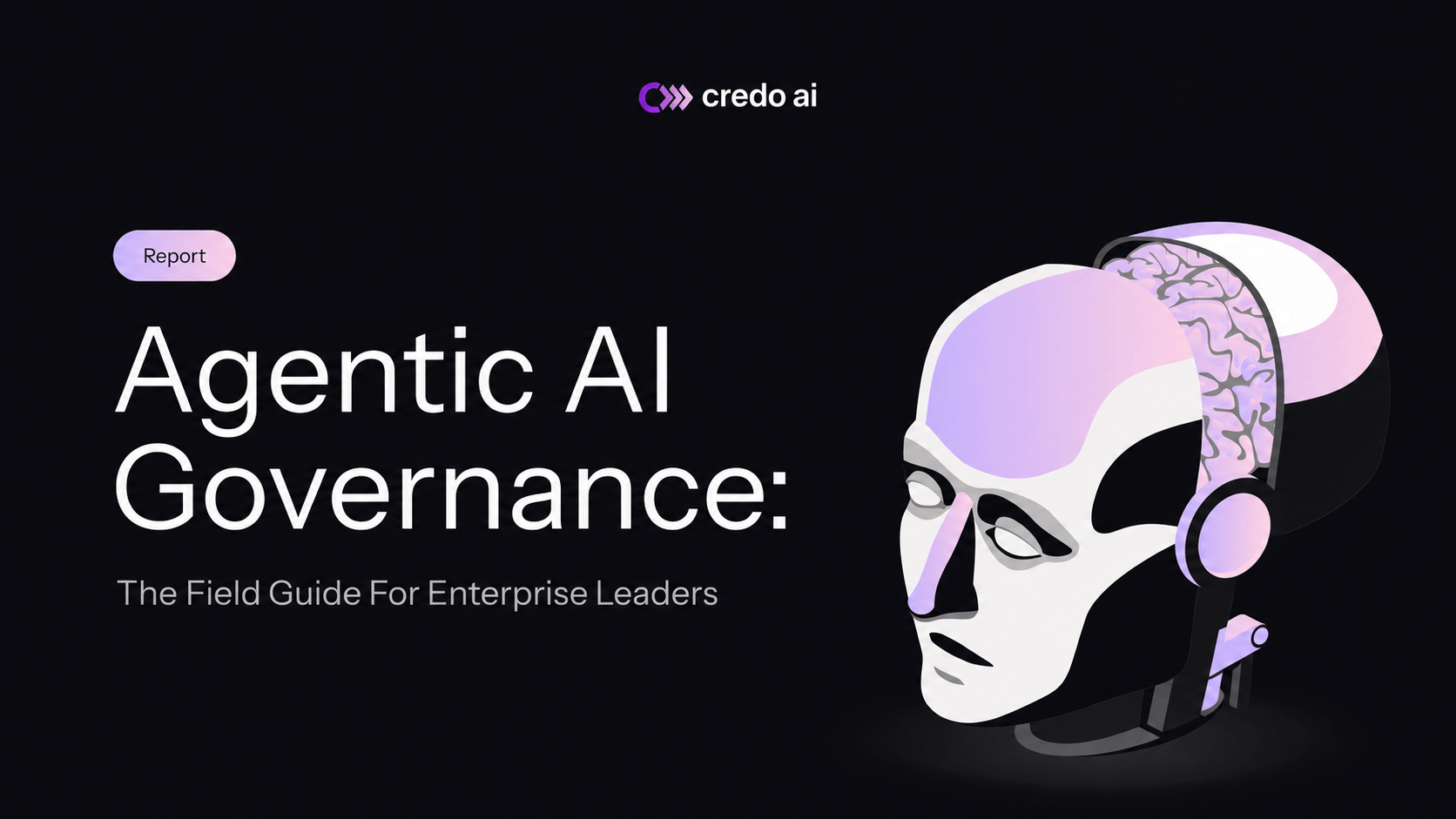
Credo AI has released “Agentic AI Governance: The Field Guide for Enterprise Leaders,” a substantial 48-page report that tackles the third major inflection point in enterprise AI governance. Building directly on Credo’s foundational 2020 framework — which emphasized contextual, continuous, and comprehensive governance — this guide explains why the shift to agentic AI demands a fundamentally new architectural approach rather than incremental improvements to existing processes.
The report is structured in ten sections, moving from the historical evolution of AI governance through the predictive and generative eras, into the specific requirements of the agentic era, and finally to practical structural components, tests, maturity assessments, and forward-looking recommendations. It draws on Credo AI’s extensive enterprise deployment experience and data from their State of AI Governance surveys to provide both conceptual clarity and immediately actionable guidance for leaders.
This is one of the more mature and enterprise-focused pieces published on agentic governance so far. It avoids hype and instead focuses on the hard architectural and organizational changes required as autonomous agents move from experimentation into production environments.
Key Findings
Agentic AI is scaling at an unprecedented rate: an 8x increase in enterprise apps embedding AI agents in just one year (from under 5% to 40%).
Multi-agent workflow usage grew 327% in only four months, showing agents are becoming exponentially more complex and interconnected.
57% of large enterprises already have AI agents running in production today.
There is a severe governance gap: 60% of organizations are deploying AI across multiple departments or company-wide, but only 4% are governing it at scale.
80% of senior AI governance leaders rate automated safeguards capable of blocking policy-violating agents as a critical capability.
Over 40% of agentic AI projects are at risk of cancellation by 2027 without proper governance structures in place.
Organizations with fully integrated AI governance are nearly 4× more likely to report revenue growth (58% vs 15%) than those still in pilot stages. The difference is accountability, not model performance.
Most tools marketed as “agentic governance” today are actually security or observability solutions — strong at monitoring but lacking core governance elements such as sanctioned purpose, agent cards, and constitutions.
The report stresses that governance must shift from external, periodic oversight to an internal architectural layer embedded in how agents are defined, constrained, and continuously validated.
What the Report Covers
The report begins by tracing the evolution through three AI inflections. It explains how predictive AI focused primarily on model risk, generative AI expanded the scope to include prompt engineering, content safety, and third-party models, and now the agentic era requires governance that operates inside the system at the speed of autonomous action. The authors make a compelling case that external monitoring alone is no longer adequate when agents can plan, use tools, and execute independently.
The core section details six structural components required for true agentic governance: the AI Agent Registry as the authoritative record of every agent, the Agent Card as a live governance-grade record for each agent, the Agent Constitution as inviolable principles the agent cannot reason around, the Pre-Deployment Gate as a formal approval process, the Runtime Governance Layer for continuous validation, and the Tool Gateway for action-level enforcement before execution. Each component is explained with practical examples and why it matters for accountability.
Later sections provide five practical tests leaders can use to evaluate their current programs or vendor solutions, an assessment of adjacent tools (primarily security and observability platforms), the connection between comprehensive governance and organizational trust, and a maturity assessment table showing where most enterprises currently stand (largely “Not Yet Production-Grade” on core agentic components).
Our Take
AI Governance Take
Credo AI’s field guide stands out as one of the most grounded and useful contributions to the agentic governance conversation so far. Rather than adding more abstract theory, it delivers a clear architectural blueprint built around six concrete structural components and five practical tests that governance teams can apply immediately.
The central argument — that governance must move from an external oversight function to an internal architectural layer embedded in how agents are defined, constrained, and continuously validated — is particularly strong and consistent with GAIG’s long-standing emphasis on architecture over documentation. The distinction between the “brain” (governance) and the “muscles” (security and observability tools) is especially helpful for leaders trying to cut through vendor marketing noise.
For enterprise governance, compliance, risk, and security teams, this report should serve as a primary reference when designing internal frameworks, evaluating vendor solutions, or pushing back on purely technical approaches that lack real accountability mechanisms. The maturity assessment table alone makes it valuable for honest self-evaluation.
This guide reinforces a key reality: the organizations that thrive in the agentic era will be those that treat governance as a core part of system architecture from the beginning, not as a compliance layer added afterward.